


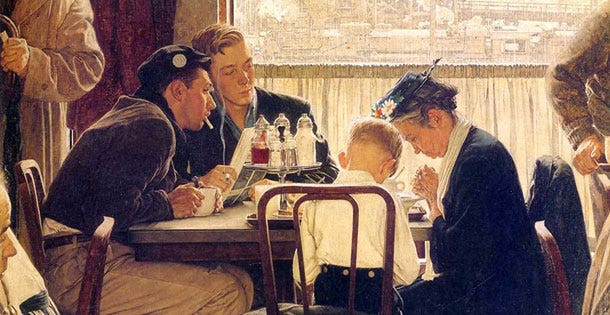
Well, here it is, Thanksgiving. That time of beer out in the garage, flag football out back, aunties in the kitchen, and uncles in the den. Retailer-sponsored parade on TV, bowl game in the afternoon. It’s all those things that bind our families together, and bring us back into the company of people we love.
And it’s the day we remember how blessed we are, as a nation. We remember our pilgrim forefathers, coming to this new land to worship in peace. We remember how they made friends with the native Americans, who helped them prosper. We make much of that prosperity, and we remind ourselves that we are Free.
That is not the story the Europeans told, of course. And it’s not the story the Narragansetts and the Wampanoags told, either, about the coming of the Puritans. And except for 1781, it’s not always clear what we mean by ‘free’, or whether it isn’t also true that most other nations in the world are free too. It’s just language we use, creation mythology, and nations do this. I do this. Back at the beginning of nations, people did this; the Bible is chock-full of tribal retellings of things in the same general manner, and that’s the way we are as humans.
What I’d observe about Thanksgiving, the way we do it, is that we run the danger of regarding a nation under God, as we like to think of ourselves, as celebration of a contract. When we say ‘Thanksgiving’, at least as I look at my life experience, we’ve gotten into a habit of thinking that we’re the sort of nation that God likes, and that as long as we behave as we’re sure we’ve done, God will look after us. (What nation doesn’t do this? German army belt buckles in WWI had Gott mit uns embossed on them. Abraham Lincoln, when assured that God was on our side in the Civil War, was obliged to observe that a better goal was for us to be on God’s side.) And we of course, like all people who mean well, take it on ourselves to decide what behaving like God’s people means. And for that matter, we decide what being God should mean. (Again, me too … I’ve caught myself doing this.)
We even baptise all of this with Covenantal language, our prosperity and freedom agreement with God. We think it’s biblical to be Americans.
I want to suggest something here.
I want to remind us that God is a parent. Not a treaty partner. God is a parent, who provides. What’s more, he provides more – and I’ll just say it – than we deserve. And he does this not because we’ve been good kids or bad kids. He does it, and does it, and keeps doing it, because it’s in the nature of good parents to provide. It isn’t because we’re good kids or bad kids that he provides. We get provided for because we are those kids. We’re loved.
That’s not a contractual arrangement. And I’m not sure it’s really even a Covenant. It’s a family. And we’re just kids.
Which gives me an idea. If giving thanks isn’t about national terms and conditions, and isn’t really about Covenant, what about recasting Thanksgiving as thanksgiving? How would it be to focus on bounty, on generosity … on Grace. Because when we Americans say ‘Thanksgiving’, we aren’t really talking about this, most of us. At least I don’t think we are.
I’m experimenting this year on myself, with replacing the ‘Thanksgiving’ term with … gratitude. Just … gratitude. There’s no contract implied. There’s no eyes on us. There are eyes only on God, the source of what we’ve been given. There’s no congratulating ourselves for being worthy of any of his munificence.
This is what I preached on Sunday. I did it brazenly, because this eye-on-gratitude is exactly what the appointed scriptures seemed to say.
Jeremiah has God put it this way:
“I myself will gather the remnant of my flock out of all the countries where I have driven them and will bring them back to their pasture, where they will be fruitful and increase in number. 4 I will place shepherds over them who will tend them, and they will no longer be afraid or terrified, nor will any be missing.
Good. But the line before that was this:
“Because you have scattered my flock and driven them away and have not bestowed care on them, I will bestow punishment on you for the evil you have done,”
But the day will come when you will live in safety, under the Lord Our Righteous Savior.
We won’t deserve bounty, in other words. We get it anyway.
Paul and Timothy (by tradition) put it another way – watch for the same dynamic:
He has rescued us from the dominion of darkness and brought us into the kingdom of the Son he loves, in whom we have redemption and the forgiveness of sins … in whom God was pleased to have all his fullness dwell, and through whom he reconciled to himself all things.
We have an inheritance. Bounty is ours, because bounty is ours. We eat well in this family, as it were. And like all inheritances, what we get is more or less undeserved … we didn’t work for it – an inheritance of light, and abundance, and the absence of fear. Just … because. That’s good parenting, is what it is.
And Jesus, in our third reading, said to the robber next to him on Golgotha, to the sneers of the watching and transactional world, don’t worry … I’ll have you with me in paradise today. That robber knew to rebuke the other robber, too, pointing out rightly that we deserve the trouble we’re in. We get out of it not by any earthly means, but by orienting ourselves to accept the abundance of God.
That’s a way of thinking about Thanksgiving that works for me. Because the abundance is here. And if we truly did recognise this, and accept it, and stop thinking about ourselves so much, and use God’s gifts in the spirit in which they were intended for us, we would be living like kings and queens, truly in paradise, lacking for nothing.
So why not focus on God here. That’s my experiment, with myself this year. Why not turn our eyes all the way upward, and replace the word ‘Thanksgiving’ with ‘Gratitude’. Why not picture ourselves as sons and daughters just plain being grateful, instead of a nation sizing up our prosperity and judging it, and celebrating it, and without noticing, estimating our own worthiness for having received it.
Thanksgiving cast as gratitude can be simple gratefulness for an abundance greater than we’re probably aware of, and which probably, actually, has very little to do with us or what we do.
The fact is, there’s a whole theology about this way of thinking, about gratitude, way beyond the language of covenant, or just desserts. There is a whole theology. And a living prayer practice that goes with it. There’s a gratitude theology.
I’d describe it as a one-way, heaven-pointed rejoicing, in which people of God – real people of God – scarcely even think about themselves at all, so deeply are they gazing into the benevolence of their Maker, the Author, the Provider, the perfector and finisher … the New Covenant, as Christ describes Himself.
In Philippians 4, this is exactly what Paul points out:
‘Pray with gratitude, and THEN the peace of Christ, which is bigger than knowledge or understanding, will guard both your mind and your heart.’
Keep our eyes on the Author of Life Itself, in other words, stop thinking so much about us. Ask and seek and bang on the door constantly to keep ourselves in grateful relationship to the source of Life – the giver of gifts without cost, every day and every minute. Never for an instant think that we deserve it. Live with an open, trusting, child-like pair of hands. Not considering our own efforts, or needs, or goals, or selves very much at all, knowing the whole time that the fact of God’s provision for us is, like with any good parent on whom children can rely, True.
Our lives aren’t our own. Our country isn’t our own. WE are not our own. What we have is our bedroom upstairs, with our stuff, in the house of our providing parents. Our stuff is ours, but not really ours. It’s arranged there superficially by us, but not called into existence by us.
I’m reminded of the wisdom of the writers of The Simpsons one Thanksgiving: Bart gives the table grace, and it goes: ‘Dear Lord, we’d thank you for this food, but we paid for it.’
We have a lot in this country, as every other country has. (Americans aren’t special.) None of us deserve it as much as we think. In the end, actually, nothing we have this is our own doing … or grace would not be grace. What we have is not God’s gift as a reward for work well done. That means that we have is nothing for us to be boastful about. It’s something for us to be grateful for. We are God’s artwork, created by and in Christ Jesus.
And the best way to celebrate what we like to call Thanksgiving, it seems to me, is to be what God’s Spirit makes us to be … and just be thankful to God for the family riches bestowed on us.